What Is AIO and SXO? How Search Optimization Is Changing in 2026
Learn what AIO and SXO mean in 2026, how they differ from SEO, and how combining AI optimization with search experience can improve visibility and engagement.
Enlear Team
August 11, 2026
5 min read
=>
AIO
What Is AIO and SXO? How…
Enlear
A potential customer searches for a solution, but instead of opening several websites, an AI-generated result summarizes the options first. One company appears as a useful source, the customer clicks through, and then decides within seconds whether the page is worth exploring. That short journey explains why AIO and SXO are becoming important parts of modern search strategy.
SEO still provides the foundation, but visibility alone is no longer enough. Content also needs to be understandable to AI systems and useful to the person who eventually reaches the website. That is where AIO and SXO address two different parts of the same search experience.
What Is AIO?
The AIO meaning can vary because the acronym is still used differently across the search industry. In this article, AIO means AI Optimization, which focuses on making content easier for AI-powered search systems to discover, understand, reference, and recommend. Google itself uses the term AI Overviews for its generated search summaries, so the two meanings should not be confused.
AIO does not mean creating a completely separate version of content for AI. Google’s currentguidance for generative AI in Search states that existing SEO fundamentals remain relevant for AI-powered search experiences. Helpful content, crawlability, internal linking, clear information, and reliable sources still provide the foundation.
The difference appears in how the content is written and supported. A vague article may target the right keyword but provide little information that an AI system can confidently use in an answer. A stronger page gives a direct explanation, adds subject-matter expertise, provides specific examples, and supports important claims with credible evidence.
What Helps With AIO?
AIO works best when content is developed around real information rather than artificial optimization techniques. Google specifically recommends valuable, unique, non-commodity content instead of simply reproducing information already available elsewhere.
Useful AIO practices include:
Answering specific questions clearly
Adding first-hand or expert knowledge
Using descriptive headings and logical sections
Supporting claims with reliable sources
Including concrete examples, comparisons, and limitations
Keeping important information available as readable page text
These practices also align with Google’s broader guidance onhelpful, reliable, people-first content. Original information, demonstrated expertise, accurate sourcing, and content that leaves the reader with a useful answer remain important signals of quality.
What Is SXO?
SXO stands for Search Experience Optimization. While SEO concentrates heavily on helping the right page become discoverable, SXO looks more closely at what happens when the user reaches that page. The goal is to connect search intent with a useful website experience that helps the visitor continue toward the next step.
Consider a service page ranking for exactly the right keyword. If it loads slowly, opens with an unclear message, hides useful information below several promotional sections, or makes the next action difficult to find, the ranking has produced traffic without creating much value. SXO addresses that gap between being discovered and delivering a satisfying experience.
Google does not use SXO as the name of a separate ranking system, but its guidance strongly supports the underlying principles. Itspage experience guidance recommends looking at the overall experience instead of optimizing one isolated metric. Mobile usability, secure browsing, accessible main content, limited intrusive elements, and Core Web Vitals all contribute to a better experience.
How Are AIO and SXO Different?
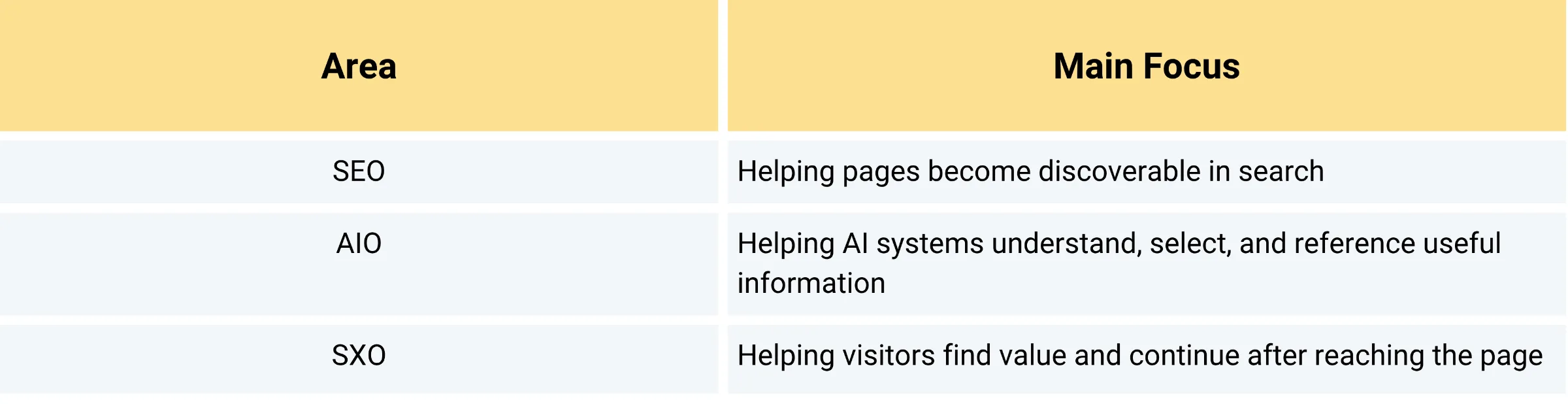
AIO and SXO solve different problems, but both begin with understanding what the audience actually needs. AIO focuses more on whether search and AI systems can identify valuable information from a page, while SXO focuses more on whether the person receiving that information has a useful experience. Neither should be treated as a replacement for SEO.
A simple way to separate them is:
Difference of SEO, AIO and SXO
The boundaries are not always strict because good content supports all three. Clear headings can help search systems understand a page while also helping users scan it, and expert explanations can improve both authority and usefulness. Strong search strategy increasingly depends on these areas working together instead of operating as separate tactics.
Why Do AIO and SXO Work Better Together?
AIO can help a page become visible inside an AI-driven search journey, but that visibility loses value if the website experience is weak. SXO can create an excellent experience after the click, but it cannot help much if search systems struggle to discover or understand the content. Focusing entirely on one side creates an incomplete search strategy.
This becomes particularly important for technical and B2B websites. A developer researching an API, for example, may first encounter a concise explanation in an AI result and then visit the source for architecture details, documentation, limitations, or implementation guidance. The content needs to earn that initial visibility and then justify the visit.
How Can a Website Improve Both AIO and SXO?
The process should start with the audience rather than with a new acronym. Identify the questions potential customers or developers actually ask, then create pages that answer those questions with direct explanations, expert input, examples, and evidence. After publication, check whether the page is technically accessible and whether visitors can quickly understand what to do next.
Page experience deserves the same attention. Clear navigation, readable layouts, relevant internal links, useful calls to action, mobile performance, and fast interaction help turn discovery into a meaningful visit. Google’s current guidance also makes it clear that there is no single page-experience metric that guarantees rankings, so the complete experience matters more than chasing one perfect score.
Final Thoughts
The question is no longer whether businesses should choose SEO, AIO, or SXO. Search is becoming a connected journey where content needs to be discoverable, understandable to AI systems, and genuinely useful when a person reaches the website. Each discipline addresses a different part of that journey.
Understanding what is AIO helps businesses prepare content for AI-driven discovery, while SXO keeps the human experience at the center after that discovery happens. The strongest strategy does not chase every new search acronym separately. It builds technically accessible, expert-led content around real user needs and makes the experience after discovery just as strong as the visibility that created it.
Based on our experience working with SEO in 2026, this article explains how AI Overviews changed the way we approach rankings, keywords, content research, expert input, and traffic. It shares the practical lessons that pushed us toward more experience-led, useful content while keeping traditional SEO foundations in place.
Learn what makes content more citable in AI search, from first-hand experience and clear answers to credible evidence, technical SEO, and useful structure.
Learn the difference between SEO, AEO, and GEO, how they work together, and how to improve visibility across traditional and AI-powered search in 2026.
 Enlear