Our SEO process used to follow a fairly clear path. We researched keywords, studied the pages already ranking, created the article, optimized it, and then watched rankings and organic traffic. When a page moved higher in Google, we expected traffic to follow. Over time, that connection became less reliable.
Some pages could maintain strong visibility without producing the clicks we expected, while AI Overviews were answering more questions directly inside search. That made us reconsider whether ranking alone was still enough to measure good SEO.
What We Noticed When Rankings Stopped Telling the Full Story
The first change we noticed was in the relationship between rankings and clicks. Searchers could now get definitions, summaries, comparisons, and basic explanations without immediately opening a website. For informational content, that changed the value of simply holding a strong organic position.
The Evergreen analysis of SEO trends in 2026 reflects the same pattern. Research referenced there shows that AI Overviews can reduce organic click-through rates for some searches, although the impact varies between topics and industries. That changed how we looked at keyword opportunities. Instead of asking only whether a keyword had good search volume, we started asking what the reader would still need after Google had already answered the basic question. That remaining gap became more important to us than the keyword itself.
Why We Did Not Replace SEO With an AI Search Strategy
When AI overviews became more visible, new terms such as GEO, AEO, and AI SEO started appearing everywhere. It was tempting to think that traditional SEO needed to be replaced with an entirely new system. Our experience pointed in another direction. Google's guidance for AI features in Search confirms that the same SEO foundations still apply. Content still needs to be crawlable, indexed, useful, understandable, and technically accessible before it can appear across Google's AI search experiences.
So we kept keyword research, technical SEO, internal linking, search intent, and content quality in the process. What changed was what came after those basics.
Previously, the thinking was often:
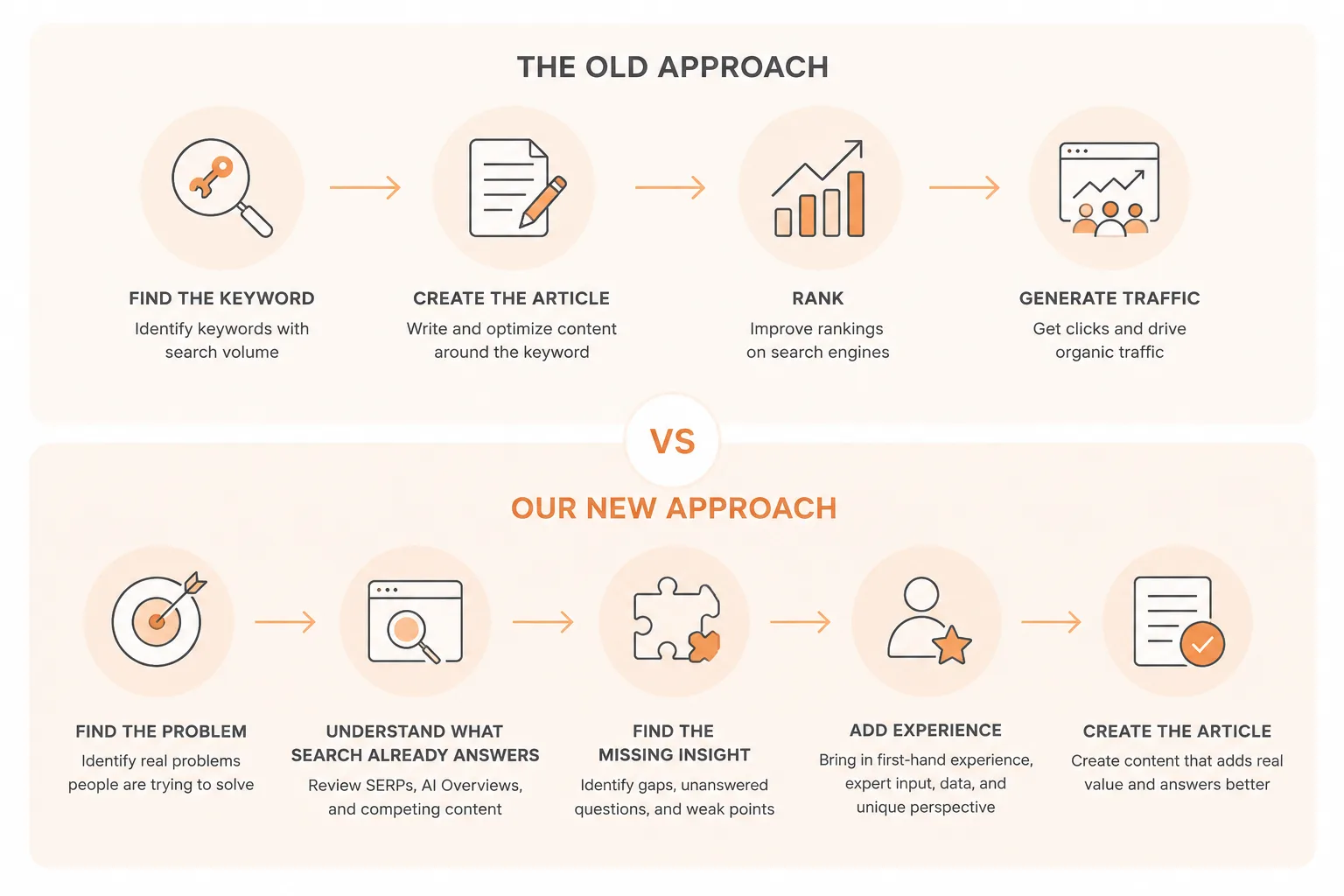 The keyword still tells us what people are looking for. It no longer tells us everything we need to say.
How Our Content Research Changed
Competitor research used to heavily influence our outlines. If most ranking articles covered the same five or six sections, it was easy to create another article using a similar structure. The result could be technically complete but still add very little to the topic. Now we spend more time looking for what those pages are missing. Maybe everyone explains the benefits, but nobody discusses where the approach fails.
Maybe the search results describe how something works but never explain what happens when a real engineering or marketing team tries to apply it. This is where our experience becomes useful. Campaign results, engineering discussions, SME interviews, customer questions, failed approaches, and lessons from actual projects often give us a better angle than another hour of competitor research. The outline then becomes less about copying what already ranks and more about building around the information gap.
Why First-Hand Experience Became More Important
Generative AI made generic content much easier to produce. Definitions, best-practice lists, comparisons, and basic guides can now be created quickly, which means another article repeating the same information has less value than before. We noticed that stronger technical content usually includes details that come from actually doing the work. It might explain why a campaign attracted traffic without creating meaningful product interest, why an engineering approach failed under production conditions, or what an expert learned after implementing something several times.
Google's guidance for generative AI search also emphasizes unique, non-commodity content and first-hand expertise. That aligns closely with how our own content process has changed. The article still needs accurate research, but research alone is no longer enough. The experience is what gives the reader something that another summary cannot easily reproduce.
How Working With Experts Changed Our Process
We also changed when subject-matter experts enter the writing process. Previously, an engineer or specialist might review the finished article mainly to confirm technical accuracy. That helped correctness, but it did not always capture their most useful experience.
Now we try to involve experts earlier. Instead of only asking whether something is correct, we ask where teams usually get it wrong, what happens in real implementations, which trade-offs matter, and what they would challenge in the advice already ranking.
Those conversations often produce the best parts of the article. The writer brings the research and structure, while the expert adds the details that are difficult to find through search alone. That combination has become especially important as AI makes basic information easier to generate.
What AI Overviews Changed About the Way We Write
We also became more selective about how much time an article spends explaining basics. If the reader has already seen a short AI-generated answer, repeating the same definition for several paragraphs gives them little reason to continue. Instead, we try to answer the main question clearly and move into context, examples, limitations, and experience sooner. The content still needs enough explanation to stand on its own, but it should not spend half the article repeating information that can already be found everywhere.
This does not mean writing only for AI systems. Google does not require a special content format for AI Overviews or AI Mode, so the priority remains creating something useful for the reader. The difference is that every section now needs a stronger reason to exist.
How We Measure SEO Differently Now
Rankings and organic traffic still matter to us, but we no longer treat them as the complete result. A visitor who wants a basic definition is different from someone researching a technical problem, reading related articles, visiting a product page, and returning later. That is why we pay more attention to what happens after the click. Engagement, conversions, product discovery, related-page visits, and the quality of the search intent give us more context around whether the content is actually useful.
AI Overviews may reduce some basic informational clicks, but that does not automatically mean the SEO strategy is failing. The more useful question is whether the content is reaching the right audience and moving them toward something meaningful. That has become a better way for us to judge the value of organic search.
What Our SEO Process Looks Like Now
Our process still begins with search demand, keyword research, competitor analysis, and technical SEO. The difference is that we now add another question before creating the outline: what can we contribute that the existing search results do not already explain well?
A typical process now looks like this:
-
Find a search problem that matters to the audience.
-
Review what Google and existing articles already answer.
-
Identify the missing information or weak explanation.
-
Add experience from experts, projects, customers, or real results.
-
Build the article around that insight and support important claims with credible sources.
-
Measure what readers do after discovering the content.
This still produces SEO-friendly content, but SEO does not dominate the article. Search research gives us the opportunity, while experience gives us the angle.
Final Thoughts
AI Overviews have not made us abandon SEO. They have made us more careful about publishing content that simply repeats what already exists, because search engines can increasingly summarize that information before a reader ever visits the page. Our approach has therefore moved from asking only "How can we rank for this keyword?" to asking "What can we add to this topic that the reader has not already seen?" SEO helps us understand the demand, but experience is increasingly what gives the content a reason to be read.
FAQ
Are AI overviews making SEO less important?
AI Overviews have changed how people interact with search results, but the main SEO foundations still matter. Pages still need strong technical accessibility, useful information, and clear structure before they can perform well in traditional or AI-powered search.
Should content be written differently for AI search?
Content should be clear and easy to understand, but it does not need a special AI-only structure. We focus more on answering the question quickly, then adding experience, evidence, examples, and context that make the article useful beyond the basic search answer.
What should content teams change in 2026?
Keyword research should remain part of the process, but it should not become the whole content strategy. Teams should spend more time finding information gaps and bringing in first-hand experience, expert knowledge, real examples, and original observations.
 Enlear