SEO is not dead. But the version of SEO that only focused on ranking high and waiting for clicks is becoming weaker.
For years, businesses followed a familiar process. Find keywords, publish content, build links, improve technical SEO, and try to reach the first page of Google. That still matters. Site speed, crawlability, schema, internal linking, and helpful content are still part of the foundation.
But in 2025 and 2026, search started moving in a different direction. Google’s AI Overviews and AI Mode began answering more questions directly inside the search results. ChatGPT also became a search destination with ChatGPT Search, giving users answers with links to web sources.
This means SEO is no longer only about ranking. It is also about being trusted, cited, summarized, and selected by AI systems.
2025: The Year AI Search Became Impossible to Ignore
In 2025, AI search moved from a side discussion to a real marketing problem.
Google expanded AI Overviews and introduced AI Mode, which changed how people interact with search. Instead of typing a short keyword and clicking through multiple websites, users could ask longer, more detailed questions and get an AI-generated answer at the top of the page.
For businesses, this created a new challenge. Even if a website ranked well, the user might get enough information from the AI answer and never click.
That is why 2025 forced marketers to rethink the meaning of visibility. A page could still appear in search, but that did not always mean it would receive traffic. The real question became:
Is our brand part of the answer?
According to Ahrefs’ 2025 analysis, AI Overviews were associated with a lower click-through rate for top-ranking pages on informational searches. This did not mean SEO stopped working. It meant informational content had to work harder.
A basic article that simply repeats what ten other websites already say became less useful. AI could summarize that kind of content easily without needing the user to visit the source.
The stronger approach in 2025 was to create content that added something AI could not easily replace, such as:
-
Expert opinion
-
Original examples
-
Product experience
-
Real data
-
Clear explanations
-
Strong brand positioning
-
Practical next steps
This was the beginning of a shift from generic SEO content to expert-led content.
2026: The Year AI Search Becomes a Performance Channel
In 2026, the situation became more serious. AI search was no longer just something marketers discussed in webinars. It became part of reporting, strategy, and performance measurement.
Google introduced Search Generative AI performance reports in Search Console, giving some site owners more visibility into how their content appears inside generative AI features. This matters because marketers need to know whether their content is only ranking in traditional search or also showing up inside AI-generated results.
At the same time, the click problem became clearer. Ahrefs’ 2026 update reported that AI Overviews were associated with a much bigger drop in click-through rate for top-ranking pages than its earlier 2025 study.
This is why 2026 SEO is less about chasing impressions and more about proving business value.
A page may receive fewer clicks than before, but the visitors who do click may be more qualified. Google has also advised site owners to look beyond click volume and understand the value of visits from AI search experiences.
That changes how SEO teams should report success. Instead of only tracking rankings and traffic, teams need to track:
In 2026, SEO becomes closer to brand strategy, content strategy, and conversion strategy.
2025 vs 2026: What Changed?
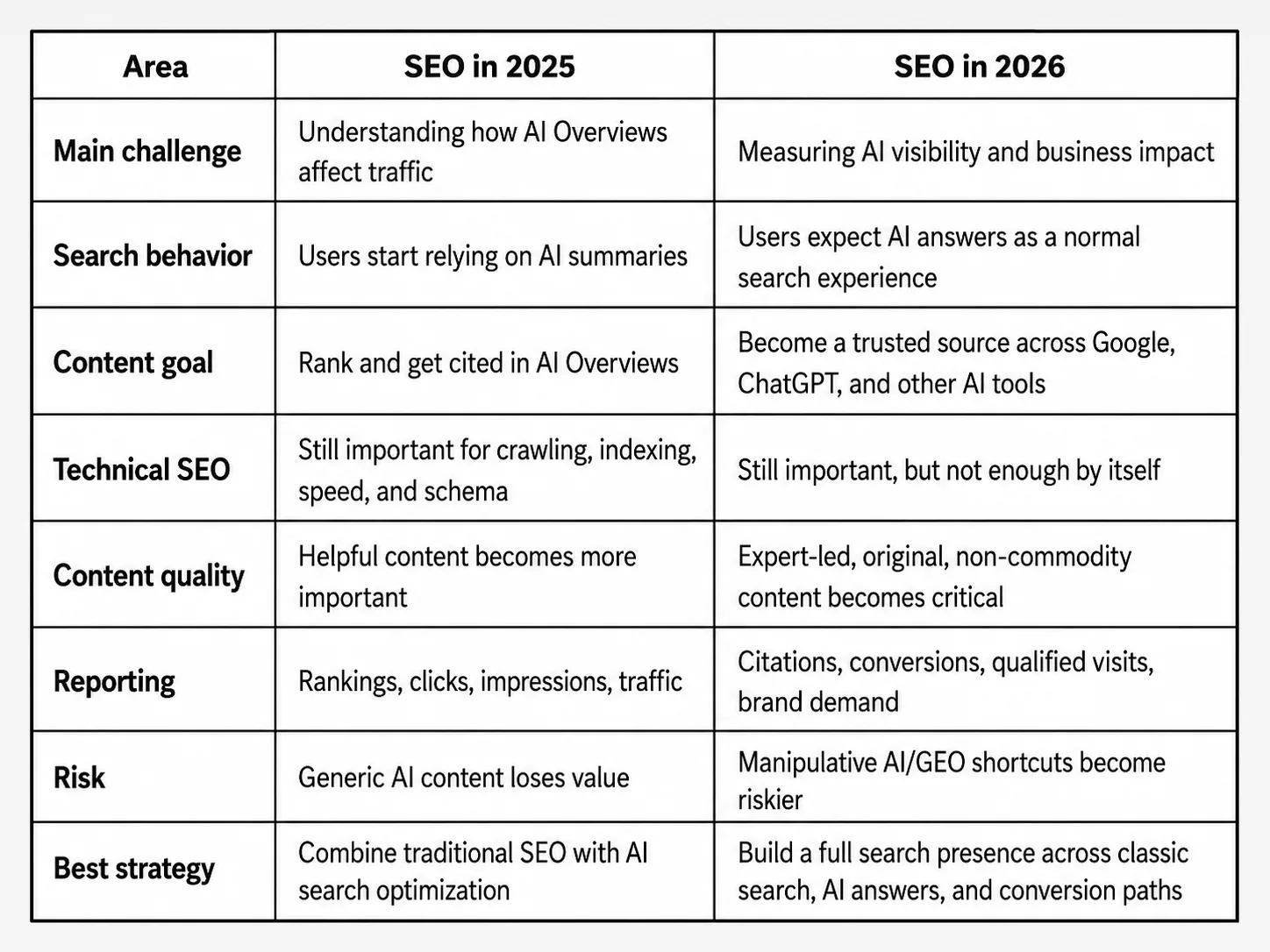 The difference is simple. In 2025, marketers realized AI search was changing SEO. In 2026, marketers have to build around that change.
Technical SEO Still Matters, But It Is No Longer the Whole Game
Some marketers hear “AI search” and assume technical SEO is no longer important. That is not true.
Google’s guidance is clear that the same SEO fundamentals still matter for AI features. Your pages still need to be crawlable, indexable, fast, structured, and easy to understand. If Google cannot access your content, it cannot show it in normal search or AI search.
So the basics still matter:
But technical SEO only gets you into the game. It does not make your content worth citing.
AI systems need content they can understand, trust, and summarize. That means your website needs clear answers, strong structure, and visible expertise.
Generic AI Content Will Not Win
One of the biggest mistakes in 2025 was using AI to publish large amounts of average content. This looked efficient at first. A business could produce dozens of blog posts quickly. But most of that content sounded the same. It repeated surface-level definitions, used similar headings, and added little new value.
That is exactly the kind of content AI search can replace.
Google’s guidance on generative AI content does not ban AI-generated content. The issue is low-value content created mainly to manipulate search rankings. Google’s spam policies also warn against scaled content abuse. So the problem is not AI writing tools. The problem is publishing content without expertise, editing, experience, or a clear point of view.
A better workflow is to use AI for research support, outlines, summaries, and editing help, but keep the real value human-led. The strongest content should include judgment, examples, original thinking, and brand-specific insight.
Brand Clarity Is Now an SEO Asset
In classic SEO, a business could sometimes rank with a page that answered a keyword well, even if the brand behind it was not very memorable.
AI search changes that.
Large language models and AI search tools need to understand what your brand does, who it helps, and why it is credible. If your positioning is vague, AI systems may summarize your business poorly or ignore it altogether.
That means your website should make the basics easy to understand:
-
What your company does
-
Who your product or service is for
-
What problem you solve
-
What makes your approach different
-
Which industries, use cases, or customer types you serve
-
What proof supports your claims
This is not only a homepage issue. Your blog posts, product pages, comparison pages, case studies, and help content should all reinforce the same brand identity.
In 2026, brand consistency helps both humans and AI agents understand you faster.
Stop Chasing Black-Hat Shortcuts
Every major search shift creates shortcuts. AI search is no different.
Some marketers are already trying to manipulate AI-generated answers with fake mentions, low-quality comparison pages, keyword stuffing, mass-produced “best tools” lists, and artificial authority signals. That may create short-term visibility, but it is risky.
Google has already clarified that its spam policies apply to generative AI responses in Search as well. So if a tactic is manipulative in traditional SEO, it is unlikely to become safe just because people now call it AEO, GEO, or AI search optimization.
The safer long-term strategy is not to trick AI systems. It is to become a better source. That means publishing content people would actually trust, cite, share, and use.
The New SEO Strategy: Optimize for Search Engines and AI Engines
The best SEO strategy for 2026 is not to abandon Google. It is also not to focus only on ChatGPT, Perplexity, Gemini, or other AI platforms. The better approach is a dual strategy.
First, keep traditional SEO strong. Your website still needs technical health, keyword coverage, content quality, internal links, and authority.
Second, make your content easier for AI systems to understand and cite. This means writing clear sections, answering specific questions, using strong definitions, including original examples, and making your brand positioning obvious.
A good AI-era article should do three things:
-
Answer the user’s question clearly.
-
Add something original or experience-based.
-
Make the brand’s expertise easy to recognize.
This is where expert guides become more valuable than basic blog posts. A strong guide does not just define a topic. It explains the problem, shows the context, gives examples, compares options, and helps the reader make a decision. That kind of content is harder for AI to replace because it contains judgment, not just information.
Measure Conversions, Not Just Clicks
The biggest mindset change is measurement.
In the old SEO model, more traffic usually looked like success. In the AI search model, traffic may decline even when visibility stays strong. That can make SEO look weaker than it really is if teams only measure clicks. A better question is “What did organic visibility help us achieve?”
For a service business, that may be consultation requests. For a SaaS company, it may be demos or free trials. For e-commerce, it may be product views and purchases. For a publisher, it may be subscriptions, newsletter signups, or returning readers.
This does not mean traffic is useless. It means traffic is no longer enough.
The most useful SEO reports in 2026 should connect content to business outcomes. Rankings still matter. Impressions still matter. But the final goal is not visibility alone. The final goal is trust that turns into action.
Final Thoughts
SEO in 2025 was about adapting to AI search. SEO in 2026 is about operating inside it. The businesses that struggle will be the ones still producing generic content for keyword volume alone. The businesses that improve will be the ones that build strong technical foundations, publish expert content, clarify their brand, avoid shortcuts, and measure real outcomes. AI search does not remove the need for SEO. It raises the standard. The future of SEO is not just about being found. It is about being trusted enough to be included in the answer.
 Enlear