A go-to-market strategy for developer marketing is not only about publishing blogs or running campaigns. It is about helping technical audiences reach developers with the right message, useful content, and a clear path toward product adoption.
Developer marketing is approached as a practical growth system for software companies, SaaS platforms, developer tools, cloud companies, AI products, and technical service providers. The work connects content strategy, technical content production, SEO, AI optimization, and developer education.
The goal is simple. Companies are supported in explaining complex products clearly, building trust with technical audiences, and turning content into measurable business growth.
What Is the Go-to-Market Strategy for Developer Marketing?
The go-to-market strategy for developer marketing helps companies reach developers at every stage of the buying and adoption journey. Developers do not usually respond well to broad marketing claims. They want useful information, technical proof, documentation, examples, and clear answers before they trust a company.
That is why the strategy focuses on understanding the developer audience, building content around real technical problems, improving SEO visibility, and creating trust before the sales conversation starts. This is not general content marketing. It is a focused approach designed for technical buyers and developer-led decision-making.
A content strategy service is built around content roadmaps, audience research, competitor analysis, editorial planning, and developer journey mapping. This makes the strategy more structured instead of treating content as one-off articles.
Why Do Companies Need Developer Marketing?
Companies need developer marketing because technical products are often hard to explain through normal marketing.
Many companies have strong products but weak product education. Their teams may understand the technology deeply, but their website does not always explain the product in a way developers can quickly understand. This creates a gap between product value and market understanding.
Developer marketing helps close that gap by answering the questions developers are already asking. What problem does this solve? How does it work? Can it be tested? Does it fit the stack? What makes it better than another option? When these answers are clear, the marketing becomes more useful. It also becomes easier for developers, technical founders, and engineering leaders to trust the company.
What Makes This Developer Marketing Strategy Different?
This developer marketing strategy is different because it combines technical understanding with SEO and content execution. Many marketing teams can write general content. Fewer can write content that explains technical problems clearly while still supporting search visibility, product education, and lead generation.
The focus is on content that developers can actually use. This includes technical blog articles, tutorials, product guides, comparison pages, SEO content, thought leadership articles, and content refreshes. This matters because developer audiences can quickly identify shallow content. If the article does not explain the problem properly, they will not trust the company behind it.
Developer marketing should not sound like a sales brochure. It should help the reader understand the problem, compare possible solutions, and see why the product is relevant.
How Is Technical Content Turned Into Product Adoption?
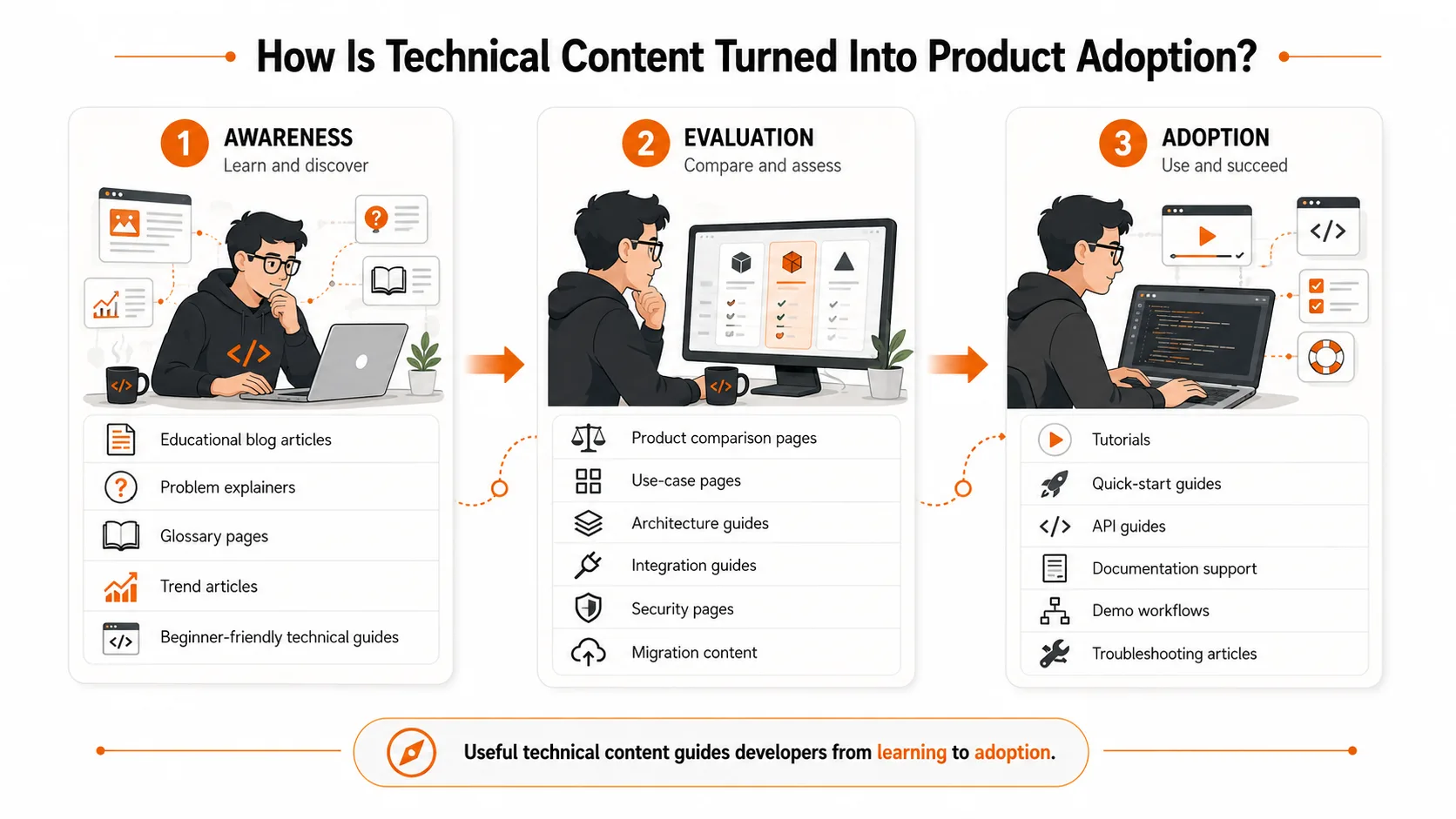 Developer marketing should not stop at awareness. The content should guide developers from learning to evaluation and then toward adoption. At the awareness stage, the developer is trying to understand a problem. This is where educational blog articles, problem explainers, glossary pages, trend articles, and beginner-friendly technical guides work well.
At the evaluation stage, the developer is comparing possible solutions. This is where product comparison pages, use-case pages, architecture guides, integration guides, security pages, and migration content become useful. At the adoption stage, the developer wants to test or use the product. This is where tutorials, quick-start guides, API guides, documentation support, demo workflows, and troubleshooting articles help reduce friction.
This is how developer marketing becomes part of the growth process. It does not only bring visitors to the website. It helps those visitors understand the product and take the next step.
Conclusion: Why This Go-to-Market Strategy for Developer Marketing Works
This go-to-market strategy for developer marketing helps reach technical audiences with content that is useful, clear, and search-friendly. The focus is on helping companies explain complex products, build developer trust, improve SEO and AI visibility, and support product adoption. This approach works because developers need proof before they take action. They want content that helps them understand the problem, compare options, and test solutions with confidence. Developer marketing becomes a long-term growth system, not just a publishing activity.

 Enlear