Paid campaigns can put a developer product in front of the right audience much faster than SEO, community building, or organic content alone. For startups, that speed can help build awareness, test positioning, and identify which technical problems attract real interest. But reach does not always lead to adoption. A strong developer marketing campaign should be judged by whether it moves the right audience closer to understanding, evaluating, or using the product, not simply by clicks or impressions.
Where Do Paid Campaigns Work Best in Developer Marketing?
Paid media works best when it supports an existing developer journey rather than trying to create the entire journey through one advertisement. The channel, message, landing page, and conversion goal should reflect how much the audience already understands about the problem.
A developer actively searching for an observability platform is in a very different position from one seeing an unfamiliar infrastructure product in a LinkedIn feed. Treating both audiences the same usually creates poor campaign economics.
Paid Search Captures Existing Technical Demand
Paid search is useful when developers already recognize the problem and are actively researching possible solutions. Queries such as Sentry alternatives, API security platform, or Kubernetes monitoring tool signal much stronger intent than a general social impression.
This makes search advertising particularly useful in established categories where developers already know what type of product they need. Search campaigns can intercept that demand and direct it toward comparison pages, technical landing pages, documentation, trials, or demos.
The limitation is important. Paid search can capture demand, but it cannot manufacture meaningful search volume for a category the market does not yet understand. If developers are not searching for the problem or terminology your product uses, increasing the advertising budget will not solve the underlying positioning issue.
Paid Social Creates Controlled Technical Reach
Paid social solves a different problem. Instead of waiting for someone to search, it allows companies to distribute technical ideas and product messages directly to relevant audiences such as platform engineers, DevOps teams, security engineers, engineering managers, and technical decision-makers.
The advantage is control over distribution, but job-title targeting alone is not enough. Within the same buying process, one developer may become the daily user, an engineering manager may evaluate operational value, and a CTO or VP of Engineering may approve the budget. Each person needs a different reason to care. Strong campaigns therefore separate the user, technical evaluator, internal influencer, and economic buyer instead of treating all engineering roles as one audience.
Why Does Technical Content Matter in Paid Campaigns?
Cold developer audiences rarely respond well to direct product promotion from companies they do not know. Developers normally want to understand the technical problem, see how the proposed solution works, and verify whether the claims are credible before moving toward a sales conversation.
That is why useful technical content often performs better as the first paid interaction.
Strong campaign assets can include:
-
Technical research, benchmarks, or engineering reports
-
Architecture, implementation, migration, or comparison guides
-
Technical webinars, tutorials, troubleshooting resources, or product walkthroughs
This is also why developer content that does not feel like marketing fits naturally with paid distribution. Advertising can buy the initial attention, but the content still has to earn technical trust.
For example, a developer may ignore a Book a Demo advertisement from an unfamiliar observability company. The same person may read an article explaining why intermittent production failures are difficult to reproduce locally, explore the related architecture, and then investigate the product behind the solution. The campaign has not avoided conversion. It has simply created enough technical context for the conversion request to make sense.
Why Do Developer Marketing Campaigns Fail?
When a paid campaign performs poorly, the advertising platform is often blamed first. Teams change bidding strategies, audiences, creatives, or budgets even though the real problem may exist much earlier in the campaign design.
In developer marketing, four problems appear repeatedly.
1. The Audience Is Too Broad
Targeting software engineers sounds specific, but it can include frontend developers, backend developers, SREs, platform engineers, security specialists, architects, engineering managers, and technical executives. Those groups can have completely different priorities.
A platform engineer may care about deployment reliability. An engineering manager may care about reducing operational overhead, while a security leader may focus on governance and risk. Strong campaigns identify who experiences the problem, who evaluates the solution, and who influences the purchase. That distinction makes both targeting and messaging significantly more precise.
2. The Campaign Tries to Sell Too Early
Developers who have never heard of a product usually have little reason to immediately schedule a sales call. Claims such as AI-powered, next-generation, or revolutionary provide very little technical evidence on their own.
A stronger campaign begins with a problem the audience already recognizes. Instead of immediately asking someone to Book an observability demo, the campaign could explain why a particular class of production failure is difficult to diagnose and show what additional runtime evidence is needed. The product then enters the conversation as part of the solution rather than as an interruption.
3. Lead Volume Becomes the Main Success Metric
Lead volume can create misleading campaign reports. A downloadable report may generate hundreds of form submissions, but many of those contacts could be students, consultants, researchers, job seekers, or developers outside the target market. A campaign with 40 highly relevant technical users can therefore be more valuable than one generating 200 generic leads.
The important question is what happens after the lead is captured. Product signups, trial activations, documentation activity, qualified accounts, product exploration, completed demos, pipeline, and revenue provide a much clearer picture of campaign quality.
4. The Landing Page Breaks the Conversation
A technically specific advertisement needs a technically specific destination. If someone clicks an ad about reducing Kubernetes debugging time and lands on a generic page about transforming engineering productivity, the campaign immediately loses the context that created the click.
The landing page should continue the same problem-solution narrative established in the advertisement. It should clearly explain the technical problem, how the product approaches it, what evidence supports the claims, which integrations matter, and what the visitor can evaluate next. Good campaigns feel continuous from ad to landing page. Poor campaigns make visitors reconstruct the story themselves.
What Role Should Paid Media Play in the Developer Journey?
Paid media should not force every developer into the same funnel. The appropriate next step depends on how familiar the audience is with the problem, the product category, and the company itself. A useful developer journey can look like:
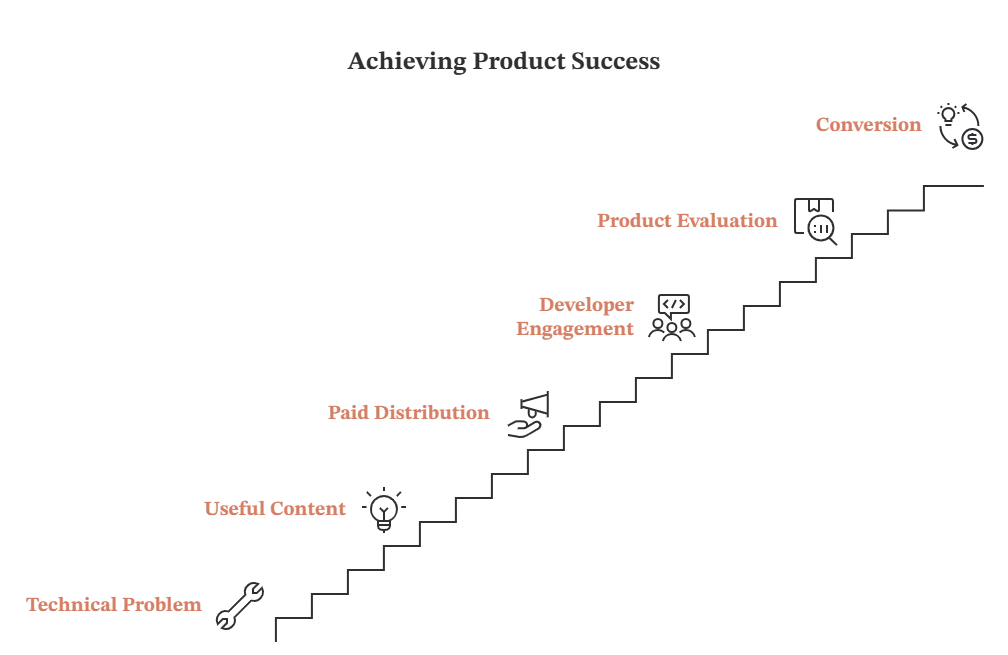 At the awareness stage, paid media can distribute technical research, educational articles, engineering insights, or problem-focused content. The objective is not necessarily to generate a sales conversation immediately but to establish relevance with the right audience.
During evaluation, campaigns can promote architecture guides, comparison content, integrations, implementation resources, technical webinars, case studies, or interactive product experiences. Higher-intent audiences can then be directed toward documentation, trials, product signups, technical consultations, or demos.
This approach gives paid media a specific job at each stage instead of expecting one advertisement to create awareness, trust, evaluation, and conversion simultaneously.
How Should Developer Campaign Performance Be Measured?
Clicks, impressions, CPM, CPC, and click-through rates still matter because they show whether the campaign can efficiently reach and attract an audience. The mistake is treating those platform metrics as proof that the campaign is producing business value.
Developer marketing needs measurement beyond the ad platform.
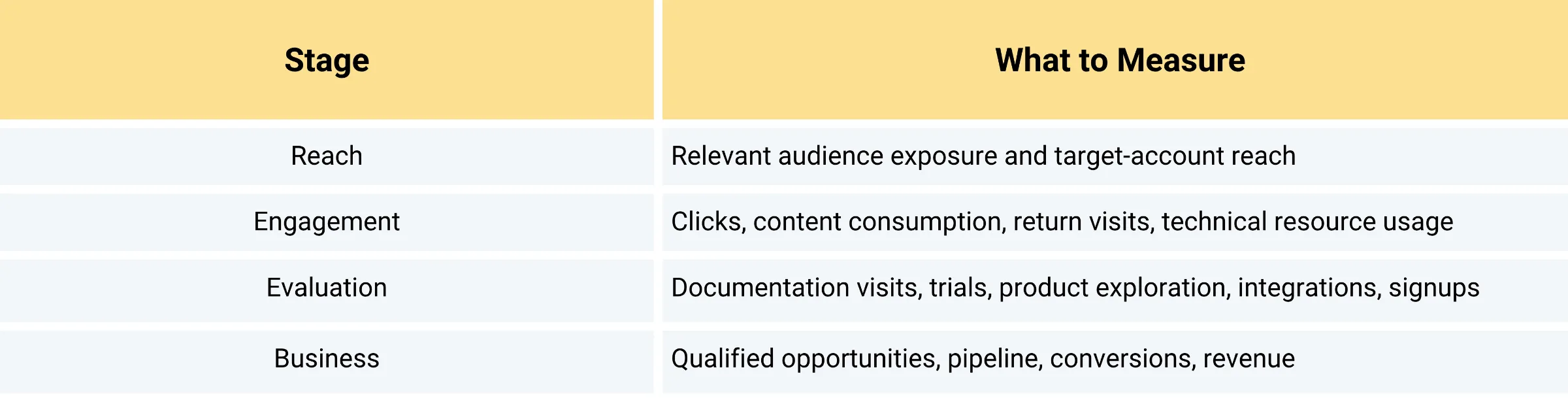 The transition between these stages is often more useful than the raw totals. A campaign with high engagement but almost no evaluation activity may indicate that the content is interesting while the product connection is weak. For longer B2B sales cycles, offline conversion tracking can also help connect an earlier advertising interaction with a qualified opportunity or eventual sale. This gives marketing teams a better view of campaign contribution when conversion happens weeks or months after the original click.
When Are Paid Campaigns Not Worth the Budget?
Paid media becomes difficult to justify when the underlying developer marketing system is not ready. If a company cannot clearly explain who the product is for, which technical problem it solves, and why developers should consider it, buying additional traffic simply exposes that weakness to more people.
The same problem appears when documentation, onboarding, technical proof, product education, or landing pages are weak. A campaign may successfully generate interest, only for developers to leave once they start evaluating the product. Paid traffic is therefore an amplifier.
When positioning, technical content, onboarding, and product experience are strong, paid campaigns can accelerate discovery and evaluation. When those foundations are weak, advertising usually makes the weaknesses more expensive.
Final Thoughts
Paid campaigns can work well in developer marketing when they support a clear technical journey. They help capture demand, distribute useful content, test positioning, and reach the right engineering audience faster.
But paid media cannot create developer trust on its own. Its real value comes from bringing the right developers into a credible path toward product evaluation and conversion.
 Enlear