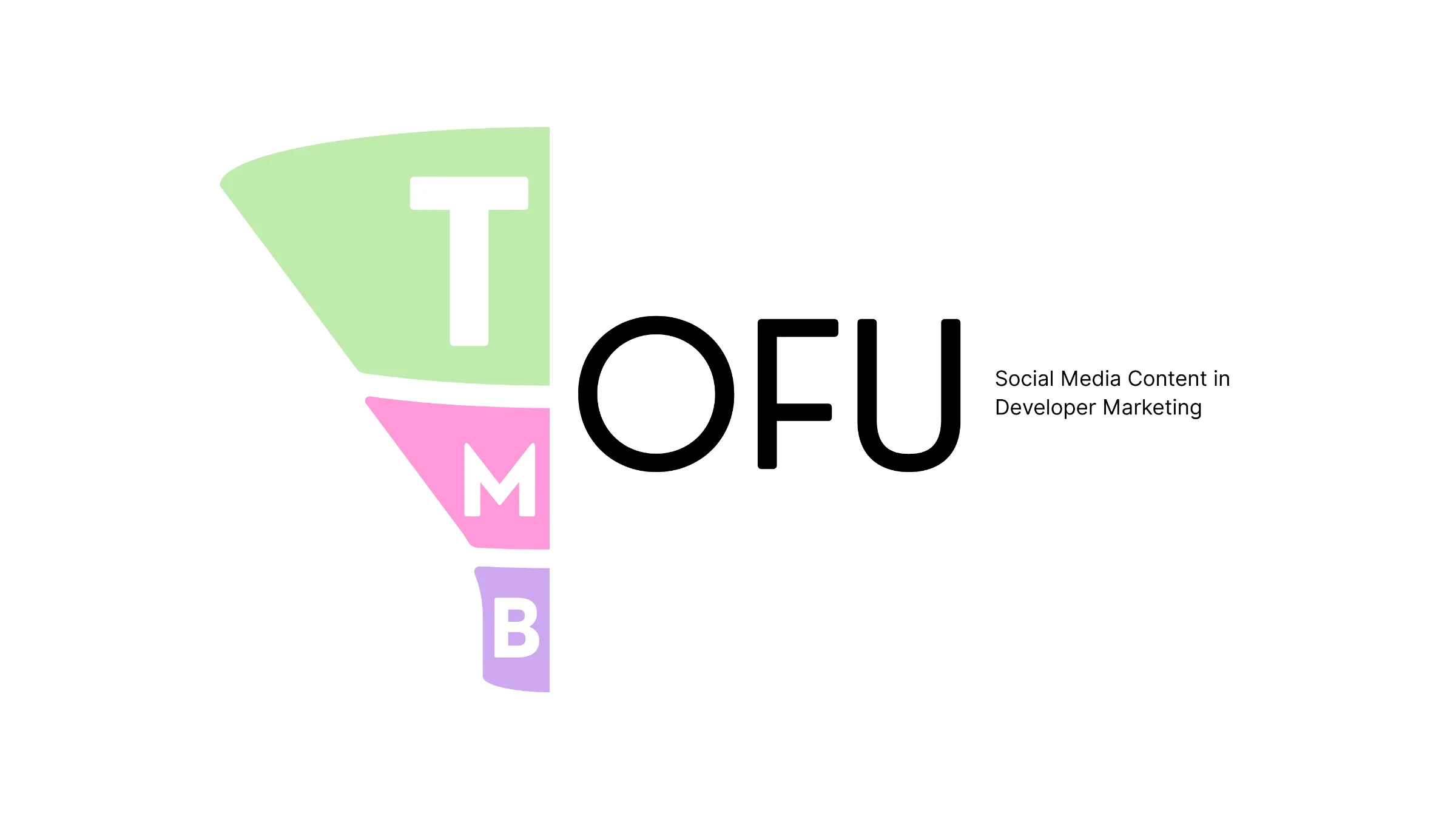
Many tech brands post frequently but see minimal conversion because every post tries to accomplish the same goal. The Top of Funnel (TOFU), Middle of Funnel (MOFU), and Bottom of Funnel (BOFU) framework solves this by assigning every post a distinct job: attract developer attention, build technical trust, or drive product adoption.
In this guide, you’ll learn what to post at each stage, how to turn one technical feature into three distinct posts, key mistakes to avoid, and how to evaluate success across your content calendar.
A Viral Reel, a Technical Tutorial, and a Case Study Have Different Jobs
Imagine three posts published by a dev-tool company within the same month:
-
A relatable developer meme gets 80,000 impressions but zero documentation clicks.
-
A step-by-step code tutorial gets 4,000 views and 600 bookmarks/saves.
-
A customer case study gets 1,500 views and 8 enterprise demo requests.
Which post performed best? Many marketing teams over-index on the meme's reach, while others worry about the low view count on the case study. In reality, each post fulfilled its specific function. The funnel framework gives you a blueprint to set clear expectations before creation and accurately evaluate performance post-launch.
Top of Funnel (TOFU): Reaching New Developers
TOFU content targets developers who aren't actively searching for your product yet or may not realize a better solution exists for their current workflow pain points. Your primary goal is brand awareness and positive recall.
Good TOFU content rarely reads like a direct sales pitch. Effective formats include:
-
Relatable memes and short clips highlighting daily engineering struggles (e.g., merge conflicts, legacy codebases, broken builds).
-
Behind-the-scenes engineering culture clips or architectural discussions.
-
Founder or Lead Architect opinions on emerging industry trends, tech stacks, or engineering practices.
-
Clean before-and-after benchmark graphics showing clear performance or speed improvements.
Example: A DevOps platform posts a 10-second terminal recording of a failing build with the caption: "Debugging CI/CD pipelines on a Friday afternoon." There is no immediate pitch just instant resonance with working engineers.
Middle of Funnel (MOFU): Building Technical Trust & Credibility
Once engineers recognize your brand, they begin evaluating your technical depth. They ask, How does this work under the hood? Does it integrate smoothly with my current stack? Is the documentation solid? MOFU content addresses these questions by teaching, demonstrating, and proving capability.
Effective MOFU formats include:
-
Step-by-step code walkthroughs and technical carousels.
-
Architecture breakdowns and deep-dive comparisons
-
Interactive video responses addressing technical questions from your community Live product walkthroughs and technical podcast clips.
For B2B developer tools, MOFU is often the most critical stage. Buying decisions involve technical evaluation, security reviews, and peer consensus. High-value educational content ensures your platform remains top-of-mind when architectural choices are being made.
Bottom of Funnel (BOFU): Driving Developer Action & Adoption
BOFU targets engineers, engineering managers, and technical leads who are ready to evaluate or implement your tool. Your goal is to eliminate friction, answer final implementation questions, and make the next step seamless.
Effective BOFU content includes:
-
Enterprise case studies highlighting concrete metrics (e.g., latency reduction, build time savings).
-
Focused end-to-end implementation tutorials and setup guides.
-
Feature breakdowns and pricing tier comparisons.
-
Single-action calls to action (e.g., "Read the Docs", "Deploy to Vercel", "Start Free Tier").
Example: A cloud database provider shares a customer spotlight post, "How [Company] scaled to 1M daily active users without dropping connection pools," paired directly with a link to spin up a free sandbox database.
How to Turn One Feature into Three Funnel Pieces
You don't need distinct topic backlogs for every funnel stage. A single product release or technical feature can supply your content pipeline across all three stages:
Scenario: Launching an Automated API Documentation Generator
-
TOFU: Short, relatable clip: "Writing OpenAPI specs manually in 2026." Focuses on the shared pain point.
-
MOFU: A carousel or video walkthrough: "How to auto-generate SDKs directly from your codebase." Focuses on the technical solution.
-
BOFU: A customer spotlight: "How [Engineering Team] cut API doc maintenance by 15 hours/week," ending with a link to install the CLI tool.
5 Common Mistakes in Funnel-Based Content Planning
-
Making every post a direct product pitch: Constantly asking developers to sign up creates immediate fatigue. Provide technical utility first, then ask for action.
-
Expecting TOFU content to yield immediate sign-ups: High-reach posts build initial awareness. Judge them on reach and engagement, then ensure MOFU content is ready to nurture those new followers.
-
Creating educational content without a logical next step: A great tutorial without a clear follow-up is a missed opportunity. Always link to a GitHub repository, a related doc page, or a CLI command.
-
Showing BOFU offers to cold audiences: Product demos and enterprise pricing comparisons work best when served to warm, engaged technical audiences who already understand your core value.
-
Measuring every post on the same scorecard: Judging a high-level engineering meme against enterprise demo conversions distorts performance data. Align your metrics directly with each post's funnel stage.
Conclusion
A successful social media strategy for developer tools isn't about increasing posting frequency it's about assigning a clear, measurable role to every piece of content you publish. By balancing TOFU awareness, MOFU technical depth, and BOFU conversion assets, you build a content pipeline that guides engineers seamlessly from discovery to adoption.
Looking to scale your technical content and reach developers authentically? Partner with Enlear to craft developer-first content strategies that drive real engagement and adoption