Developer marketing and DevRel both connect technology companies with developers, but they serve different purposes. Developer marketing builds awareness and demand for a technical product. DevRel builds developer relationships, supports successful product usage, and carries developer feedback into the company.
Their work often overlaps across technical content, events, product launches, and education. However, their main goals, communication styles, and responsibilities remain different. Understanding these differences helps companies create clearer developer programs.
What Is Developer Marketing?
Developer marketing applies marketing strategy to technical products such as APIs, SDKs, cloud platforms, infrastructure tools, and developer software. It helps developers discover, evaluate, and adopt products that address their technical needs. Its work is commonly connected to awareness, acquisition, conversion, and business growth.
Common developer marketing activities include:
- Audience and market research
- Product positioning and messaging
- Technical content marketing
- SEO and content distribution
- Product launch campaigns
- Developer newsletters
- Comparison and use-case pages
- Conversion optimization
These activities guide developers from discovering a product to taking a measurable action. That action may include reading the documentation, starting a trial, creating an account, or requesting a demo. The content must provide enough technical information for developers to evaluate the product.
What Is DevRel?
DevRel, short for developer relations, manages the relationship between a company and the developers who use, evaluate, or contribute to its technology. It helps developers understand and use the product while providing a channel for questions, concerns, and feedback. Unlike developer marketing, DevRel is strongly based on two-way communication.
A developer relation program may include:
- Developer advocacy
- Technical education
- Community engagement
- Tutorials and sample applications
- Workshops and technical talks
- Product demonstrations
- Developer onboarding
- Documentation feedback
- Developer experience improvements
- Product feedback collection
These activities help developers succeed with the product. They also help engineering, product, documentation, and support teams understand the problems developers encounter. This feedback loop is an important part of DevRel.
What Does a DevRel Engineer Do?
A DevRel engineer combines software engineering knowledge with communication and community skills. They may build sample applications, test APIs, create tutorials, deliver workshops, and answer implementation questions. Their technical experience allows them to discuss the product at the level developers expect.
A DevRel engineer may be responsible for:
- Building code examples
- Testing APIs and SDKs
- Creating tutorials and workshops
- Supporting developer communities
- Reviewing documentation
- Identifying onboarding problems
- Collecting developer feedback
- Communicating product issues internally
The role is not simply technical sales. A DevRel engineer should be able to explain product limitations, implementation challenges, and technical trade-offs honestly. This credibility helps the company build stronger relationships with developers.
What Is the Main Difference Between Developer Marketing and DevRel?
Developer marketing communicates product value to a defined technical audience and encourages evaluation or adoption. DevRel maintains a two-way relationship that helps developers succeed and allows their feedback to influence the company. The comparison below summarizes the main differences.
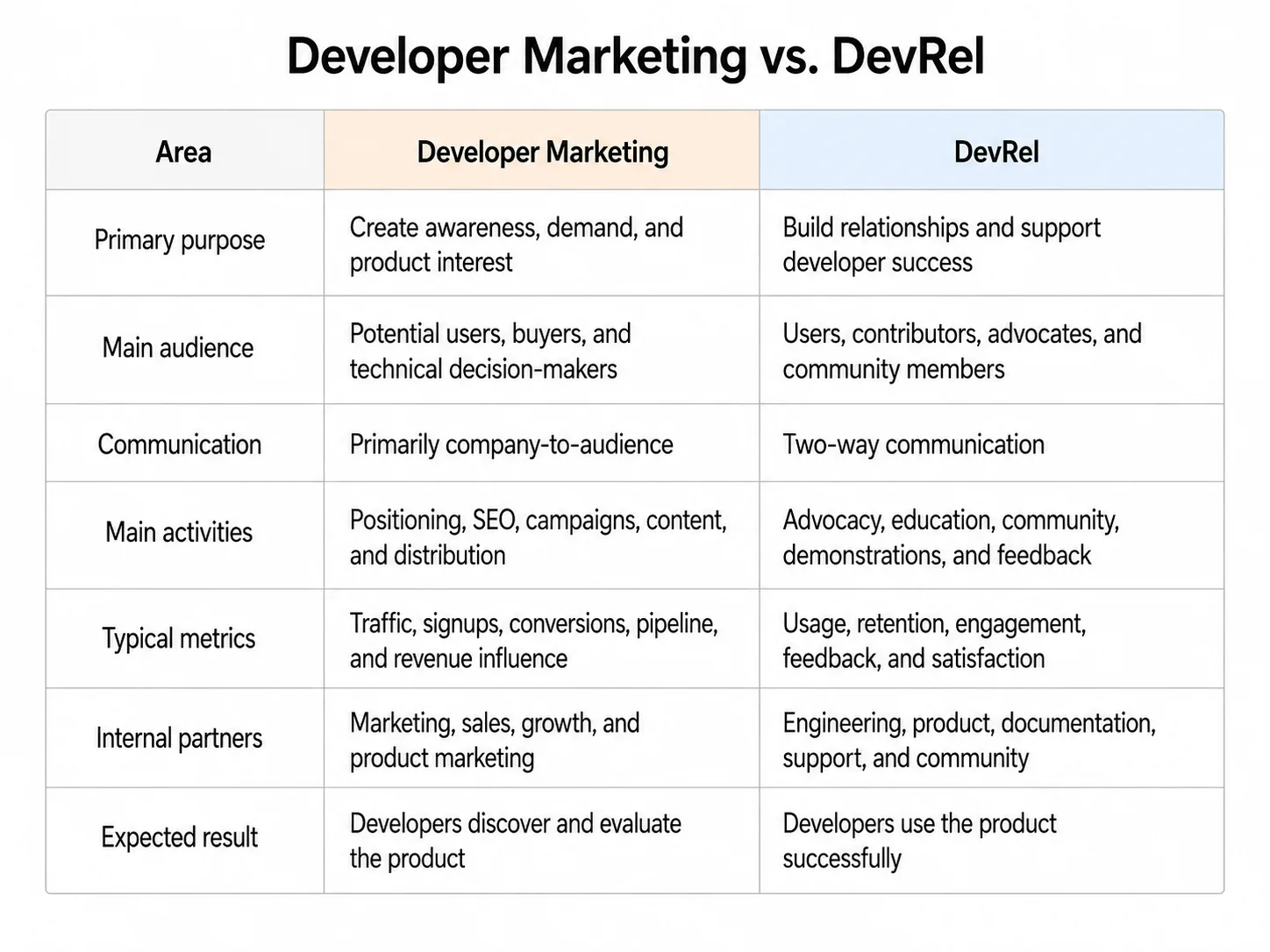 These differences describe the general purpose of each function rather than fixed organizational rules. Some companies place developer marketing within a broader DevRel team, while others operate the two as separate functions. The right structure depends on the company, product, and developer community.
Where Do Developer Marketing and DevRel Overlap?
Developer marketing and DevRel commonly work together on technical content, events, product launches, research, and product education. Marketing contributes audience knowledge, positioning, and distribution strategy. DevRel contributes technical accuracy, implementation experience, and community knowledge.
Their shared work may include:
- Planning technical content
- Supporting product launches
- Running webinars and workshops
- Researching developer needs
- Creating product education
- Sharing developer success stories
- Supporting product adoption
Clear ownership prevents repeated work. For example, developer marketing can promote a webinar and manage registrations, while DevRel develops and delivers the technical session. Cross-functional collaboration allows marketing, DevRel, and engineering teams to contribute without losing their individual responsibilities.
How Do They Collaborate on Technical Content?
Developer marketing identifies the audience, search opportunity, positioning, and distribution channel for technical content. DevRel helps ensure that the explanation, examples, and product guidance are useful to developers. Engineering or subject-matter experts may provide additional review when the topic requires deeper technical knowledge.
This collaboration can be used for:
- Tutorials
- Technical blog articles
- Product comparisons
- API guides
- Implementation examples
- Webinars
- Developer case studies
A structured SME collaboration process helps marketing teams involve developers without placing the entire writing process on them. Marketing can manage planning, writing, editing, and distribution, while the technical reviewer focuses on correctness. This approach improves quality without creating unnecessary work for engineering teams.
Can Developer Marketing Be Part of DevRel?
Developer marketing can operate within a broader DevRel program, but this structure is not universal. Some companies treat DevRel as an umbrella covering developer marketing, advocacy, community, education, and developer experience. Other companies maintain developer marketing and DevRel as separate functions.
Several factors can influence the structure:
- Company size
- Product complexity
- Number of developers served
- Community maturity
- Business model
- Available skills
- Program goals
A small company may combine both responsibilities within one team. A larger company may require separate specialists for developer marketing, advocacy, community management, and developer experience. Regardless of the structure, each activity needs clear goals and ownership.
Does a Company Need Developer Marketing or DevRel?
A company may need developer marketing when it has a useful product but struggles to reach the right technical audience. Weak visibility, unclear positioning, inconsistent content, and low conversion from technical traffic usually indicate a marketing problem. Better technical content and distribution can help developers discover and evaluate the product.
Signs that stronger developer marketing may be needed include:
- Developers do not know the product exists.
- The product’s technical value is unclear.
- Content attracts the wrong audience.
- Search visibility is weak.
- Product pages generate few signups.
- Messaging changes across different channels.
A company may need DevRel when developers can find the product but struggle to use or trust it. Poor onboarding, unanswered technical questions, limited education, and missing feedback channels usually indicate a DevRel or developer-experience problem. Increasing website traffic will not resolve these issues.
Signs that stronger DevRel may be needed include:
- Developers struggle with integrations.
- Technical questions remain unanswered.
- Documentation does not cover real use cases.
- Product teams receive limited developer feedback.
- Community participation is low.
- Developers leave after initial testing.
Many developer-focused companies eventually need both functions. Developer marketing helps the right developers discover and evaluate the product. DevRel helps those developers use the product successfully and maintain a productive relationship with the company.
Conclusion
Developer marketing and DevRel are connected but not interchangeable. Developer marketing focuses on awareness, demand, evaluation, and conversion, while DevRel focuses on technical education, successful usage, community relationships, and product feedback. Both can contribute to product adoption through different responsibilities.
The simplest distinction is that developer marketing brings developers toward a product, while DevRel supports the ongoing relationship between developers and the company. When both functions have clear ownership, they can collaborate without repeating the same work. This creates a stronger path from product discovery to successful adoption.