
If you're a marketer creating content for developers, you've likely faced this scenario: you publish a well-researched, relevant blog post, but it barely gets noticed. The content is solid, so what's missing? Often, it’s not the message, it's the hook.
A strong hook grabs attention, sets the tone, and gives readers a reason to keep going. In this guide, we'll walk you through 7 proven hook types that consistently capture developer interest, with real examples and practical tips to help you apply them to your content.
What's a Hook
A hook is the first thing your audience sees, usually the title, subject line, or social caption. It's what makes someone say, "I want to read this."
For technical content, a strong hook doesn't just grab attention; it frames the value clearly and quickly.
Think of it like writing a great commit message: it tells you what's inside, why it matters, and why you should care. For example, compare these two titles:
- Weak Hook: "Understanding API Rate Limits"
- Stronger Hook: "Why Your API Keeps Breaking at Midnight and How to Fix It"
The second version highlights the problem and hints at a solution, making it far more likely to catch a developer's eye. That's the power of a well-crafted hook.
Why Hooks Matter for Developer-Focused Marketing
Developers Are Selective. A Hook Earns Their Attention
Developers are busy and focused on solving problems. If your content doesn’t show its value right away, they'll skip it. A strong hook speaks directly to their needs or questions. For example, instead of a generic title like "Introduction to CI/CD," try something more outcome-driven like "How CI/CD Can Save Your Team Hours Each Week." The second version signals a benefit, which makes it more likely to get a click.
Try this: Before you publish, ask: What's the pain point or takeaway here? If it's not immediately clear in the title or opening, refine it.
Hooks Frame the Value Fast
Your hook is your first opportunity to demonstrate why your content is relevant. Developers don't want vague promises; they want clear signals of what they'll learn or gain. A good hook sets the expectation quickly and keeps the reader engaged.
Example:
- Weak: "Monitoring Tools for Developers"
- Stronger: "The 3 Metrics Every DevOps Team Should Track And the Tools That Help"
Try this: Use your hook to answer the reader's silent question: "Is this worth my time?"
Hooks Help You Repurpose Content
A well-crafted hook doesn't just pull readers in; it also gives you a way to reuse your content across formats. One idea can become a blog post, a social caption, an email subject line, or even a webinar, each version tailored with a different hook to reach different audiences.
Example:
- Blog post: "How We Cut Deployment Time in Half with GitHub Actions"
- Social caption: "Still deploying manually? Here's how we automated it in a day."
- Email subject line: "The CI/CD Shortcut That Saved Us 10+ Hours a Week"
Try this: Draft 3–5 hook variations for every piece of content. Test and reuse the ones that perform best.
Even Great Content Gets Ignored Without a Hook
You can write a brilliant, well-researched article, but without a clear hook, it may never be read. Developers often skim headlines and previews before deciding where to invest their time. If your content doesn't highlight its value upfront, it risks being overlooked.
Try this: Treat your hook like a commit message or a README intro;
It should immediately tell the reader what's inside and why it matters.
The 7 Hook Types, Explained with Developer-Focused Examples
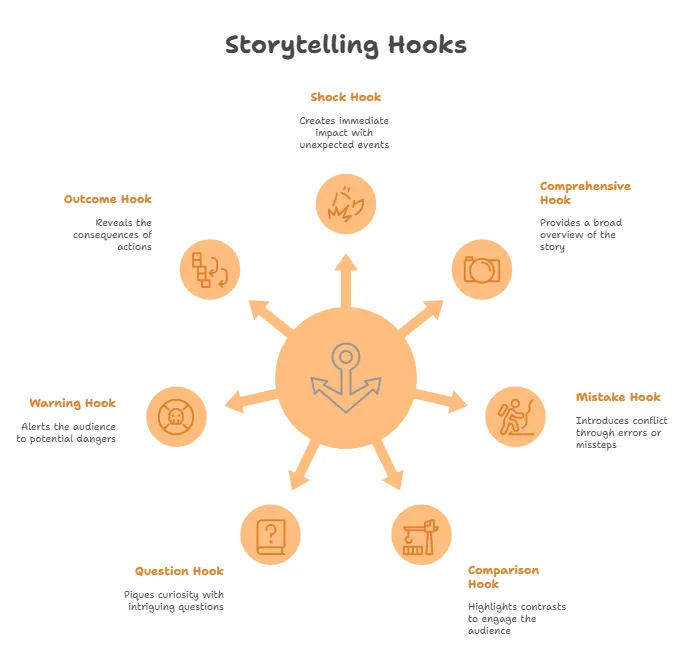
The Shock Hook
Developers are logical and pattern-driven, so when your hook breaks expectations by presenting a bold, risky, or unconventional idea, it naturally grabs their attention. It works because it challenges assumptions and sparks curiosity, prompting readers to find out how you pulled it off. Use this approach when you've done something unexpected and can back it up with real insight.
For example: "We Let AI Deploy Our Code. Here's What Happened" or "This Startup Ships Daily Without a QA Team." These types of hooks stand out and invite the reader to learn more.
The Comprehensive Hook
Position your content as the one-stop resource developers need.
This hook works because developers want reliable, complete answers without bouncing between tabs. When your headline promises a full guide, something that covers everything from start to finish, it signals that the reader can trust your content to deliver real value.
Developers appreciate efficiency and depth, so a well-organized, all-in-one resource not only saves them time but builds credibility with your brand. Use this type of hook when you're creating a detailed walkthrough, in-depth tutorial, or reference article that goes beyond the basics.
Examples:
- "Everything You Need to Know to Deploy Kubernetes in Production"
- "The Only VS Code Extensions Developers Need in 2025"
The Mistake Hook
Highlight what's not working and offer a smarter way.
This hook calls out common mistakes developers might be making, then shows how to fix them. It works because it taps into a developer's natural drive to improve, without being judgmental. When a headline hints at an overlooked inefficiency like slow unit tests or unhelpful code review habits, it creates curiosity and a reason to keep reading. It's especially effective for content that helps developers rethink familiar tasks and work more effectively.
Examples:
- "Why Your Unit Tests Are Slowing You Down" highlights a hidden performance issue in a routine process.
- "The Code Review Habit That's Quietly Hurting Your Team" challenges a familiar workflow to improve collaboration.
- "You're Logging Too Much: A Smarter Approach to Debugging" reframes a common habit and offers a more effective solution.
The Comparison Hook
Help developers choose between two real options.
Developers often face tough choices between tools, frameworks, or workflows. The Comparison Hook works by presenting a clear "either or" scenario that mirrors real decisions they're making. It gives your content instant relevance and encourages deeper reading.
When you lay out pros and cons side by side, you're not just informing, you're helping them make a smarter, faster decision. This approach works best when you're comparing solutions that solve the same problem in different ways, whether it's tool selection, architecture, or workflow design.
Examples:
- "React vs. Svelte: Which One Wins in 2025?" is a forward-looking guide for frontend teams.
- "Terraform or Pulumi: Which Should You Bet Your Infra On?" A practical breakdown for DevOps and infrastructure leads.
The Question Hook
Ask a question your audience can't ignore.
The Question Hook works by asking something developers can't easily ignore. A good question sparks curiosity; it makes the reader pause and think, "I want to know the answer to that." This approach is especially useful when you're writing about emerging trends, challenging common assumptions, or weighing in on a debate within the tech community.
Developers are natural problem solvers, so when your content poses a question they've been thinking about or one they didn't realize they should, it invites them to keep reading and engage with your perspective.
Examples:
- "Can AI Replace 80% of Your Backend Dev Work?" is a bold, timely take on automation in software development.
- "Is It Time to Ditch Feature Flags?" questions a popular practice, sparking debate and reflection.
- "Are You Over-Engineering Your API?" speaks directly to developer behavior with a self-aware prompt.
The Negative Hook
Call out a risk, then show how to avoid it.
The Warning Hook works by spotlighting a potential mistake developers may not know they're making. It's effective because developers care deeply about avoiding inefficiencies, bugs, and costly missteps. By naming a specific risk and offering a clear solution, this type of hook builds urgency and trust without sounding alarmist. It's especially useful when your content includes preventative advice, troubleshooting tips, or lessons learned from real-world mistakes.
Examples:
- "Your AWS Bill Will Skyrocket If You Don't Optimize These 3 Settings" helps developers prevent unnecessary cloud costs.
- "You'll Never Scale Your App If You Log Like This" flags a performance bottleneck linked to everyday logging habits.
- "Stop Doing This One Thing That's Slowing Down Your CI/CD Pipeline" calls out a common workflow issue with a quick fix.
The Tutorial Hook
Show the reader exactly what they'll walk away with.
This hook works by making the result clear from the start. Developers are practical and goal-oriented; they want to know what they'll be able to build, automate, or improve by the time they finish reading.
When your headline promises a specific, useful outcome, it sets clear expectations and builds trust. This approach works especially well for tutorials, integration guides, and hands-on demos that lead to something real and usable. It removes guesswork and helps developers decide quickly if your content is worth their time.
Examples:
- "Build a Slackbot That Writes Standup Summaries With GPT" offers a project with an immediate, tangible payoff.
- "Create a CI Pipeline in 10 Minutes Using GitHub Actions" delivers fast, practical value.
- "Set Up Role-Based Access Control in AWS With Just Two Files" solves a common infrastructure challenge with minimal effort.
How to Apply This: 5 Quick Wins
To make strong hooks a reliable part of your content process, start by including a "Hook" section in every content brief. Define it early before you start writing, so it guides the structure and focus of the piece. For each topic, brainstorm 3-5 hook variations using different types like shock, question, or comparison. Test them across formats (blog, social, email) to see what performs best.
Over time, track which hooks lead to the most clicks, shares, or conversions by tagging them in your performance reviews. This helps you learn which styles resonate with your audience. As your team learns what works, build a shared hook library with real examples from your own content or industry competitors. Finally, align your hook types with the content funnel: use curiosity-driven hooks (like Shock or Question) to grab attention at the awareness stage, and more practical hooks (like Comparison or Outcome) to support decision-making and conversion.
These simple practices can significantly enhance engagement, particularly with developer audiences who value content that is concise and delivers clear value.
Final Thought
Creating content that developers engage with doesn't start with writing; it starts with positioning. And that begins with the hook. A strong hook speaks to developers the way they think: clear, direct, and respectful of their time. Before you start writing, or even finalizing your headline, pause and ask yourself: Would I click on this if I were the reader?
If the answer isn't an immediate yes, it's worth rewriting. A well-crafted hook is one of the most effective ways to increase engagement, trust, and reach with technical audiences.

 Enlear