 The Rise of the Invisible Hand
Let me take you back to a moment I had just last week: I was reading a blog post on productivity. It was clean, concise, even insightful. But something felt… off. The tone was polished but a little too polished. No real-life examples. No quirky writer voice. And then it hit me: Was this written by a person or a machine?
Turns out I'm not alone.
Fun (or freaky?) fact: Up to 90% of online content could be AI-generated by the end of 2025. Tavus.io
Everyone's Using AI, So What's the Problem?
Let's be honest for a second.
We're all living in a world where everything moves fast. Deadlines are tight, there's always another project waiting, and people want content yesterday. In that kind of pressure, who wouldn't reach for a tool that can write something in a few seconds flat?
And I've seen it everywhere.
- A marketer rushing to meet a campaign deadline opens Chatgpt and types:
"Write me a quick newsletter about productivity hacks."_ Done in 30 seconds.
- A student with a midnight essay deadline?
"Summarize this research paper in a simple tone." Boom, instant draft.
- A startup founder wants to ride a trending topic but doesn't have time to write from scratch. So they copy a blog from a competitor and say,
"Rewrite this to sound fresh and casual."
And you know what? I get it. No judgment.
It's fast. It's easy. It works. Rewriting, summarizing, and spinning ideas now takes seconds, not hours. That's the magic and the danger of AI tools.
But here's the thing:
The problem isn't that people use AI to write.
The real problem is what happens after the writing is done.
Rewriting ≠ Creating
Imagine someone finds a great article on Medium, smart, useful, maybe even a bit inspiring.
Instead of building on it, they drop it into an AI tool and say: "Make this sound more casual."
Seconds later, they have a new version. Different words, same ideas. It looks fresh, but it's just the same engine in a new shell.
Now picture that happening across thousands, maybe millions of blog posts.
That's not creativity. That's content cloning.
The words change, but the soul of the piece? It never shows up.
Speed Over Quality
This is where it starts to break down. When we focus on speed over thought, content loses something real. It sounds nice, but there's no story, no spark, no sense that someone actually cared.
It's not just more content, it's more of the same content. Same tips, same tone, same tired ideas dressed up in new sentences.
And when AI is used as a shortcut instead of a sidekick, we lose quality for the sake of quantity.
What Happens When Everything Sounds the Same?
So here's the big question:
If everyone's using AI to write, how do we tell what's real?
Most people will use it, and honestly, why not? It's quick, cheap, and doesn't run out of ideas (even if you do).
In fact, by 2025, up to 90% of online content could be AI-made -Tavus.io
In a world full of machine-written words, originality becomes rare and valuable.
So What's the Real Problem?
Let's be clear: AI isn't the problem. It's a tool. A helpful one.
But it doesn't know you. It doesn't care about your story. And it doesn't feel proud when something connects with a reader.
That's your job.
The real problem? Forgetting to bring your voice to the page. Letting the tool speak instead of using it to shape your own thoughts.
Because fast writing isn't always good writing. And rewriting isn't the same as creating.
Why does it matter.
So far we've asked: Can you really tell if something was written by a human anymore?
Now let's go one step further:
Why does that even matter?
Let's hear it straight from the folks who run the world's biggest search engine-Google. According to Google's official guidelines, the issue isn't whether content is written by AI or a human.
Using automation—including AI-to generate content with the primary purpose of manipulating ranking in search results is considered spam.
In other words:
- AI is not banned.
- Low-effort, high-volume junk that adds no value? That's spam.
And spam, my friend, doesn't rank.
So yes, Google can smell AI. But more importantly, it can smell lazy content, and that's what really matters.
Can Humans Smell AI Too?
Let's be honest. You've probably read an article or email recently and thought, "This feels… robotic."
And you were probably right. We don't always catch it right away, but over time, human readers can pick up on the signs:
- Over-polished, overly generic language
- No strong opinions
- No "I've been there" moments
- Just… facts in a row
It's like eating plain oatmeal every day. Technically filling. But you'll never crave it.
That's what a lot of AI-generated content turns into, safe, smooth, but forgettable.
Spotting Spam vs. Standing Out
Google's systems, just like human brains, are getting better at telling the difference between:
- Content made to help a real person
- And content made to trick a search engine
This means that not all AI content is bad, but content without soul? That's where the red flags pop up.
Our focus is on the quality of content, rather than how it's produced. - Google Search Central
So the mission is clear: Don't just create content. Create something worth reading.
Because in a sea of AI-written sameness, original, thoughtful writing will always stand out.
And That's Where You Shine
Here's the good news. When everyone is using AI to create fast, formulaic content, you don't need to fight fire with fire. You just need to write something that feels real.
Bring in your voice.
Share your story.
Add the "why" behind the "what."
That's what turns information into connection and that's what both people and search engines are looking for.
Is Generative AI Content Bad for Marketing?
Many marketing teams today are using AI to move faster, drafting blogs, rewriting product pages, and sending out campaigns in record time.
At first, it feels like a win. More content, fewer hours. Clean copy, consistent tone. But soon the cracks show.
Search rankings start to slide. Engagement drops. Readers don't stick around.
Why? While the content looks polished, it lacks depth, originality, and connection.
Google's stance is clear:
It's not about who writes it-it's about whether it's helpful, original, and made for people. - Google Search Central
So no, AI isn't bad for marketing.
What's bad is using it without intent or insight.
The fastest content won't win. The most valuable, trustworthy, and human-centered content will.
Can we detect AI content?
We now live in a world full of AI detectors, tools that promise to tell whether something was written by a human or a machine.
Grammarly, Quill Bot, ZeroGPT, Copyscape... nearly every platform that deals with writing has added some form of AI detection.
But here's the real question:
Can they truly tell the difference?
Let's break it down through three very different writing scenarios.
Before the AI Boom , When Content Was Human by Default
Think back to the early 2010s. A developer sits down to write a blog post on building components with React.
They write from memory, from struggle, from real experience. The words are clunky at times, but honest. Raw. Clear.
This content has no automation behind it. No rewriting tools. No AI filters.
It was just… writing. If you tested that content today, most readers would sense the human touch.
It wouldn't be perfect, but it would feel real, because it was.
The AI-Enhanced Era - Human Thoughts, AI Tweaks
Fast forward to today.
A marketer or developer still writes their own content, but this time, they get help:
- Grammarly fixes their grammar.
- Quill Bot tightens a few sentences.
- An AI tool rewrites the intro to "sound more engaging."
Now the content looks smoother.
But it's also lost a bit of its original rhythm. The "you" in the writing becomes less obvious.
When AI detection tools scan this, they start to pick up signals, maybe 10%, maybe 30%, depending on how much AI was involved.
Even though the ideas were human, the fingerprints of AI remain.
It's not a false positive. It's a blended reality.
Once AI touches content even lightly, it's hard to remove its trace.
Fully AI-Generated, One Prompt, Zero Human Input
Now, take a third case. You enter a prompt:
"Write an article about serverless architecture in under 1000 words."
In seconds, you get clean copy: clear structure, bullet points, even a friendly tone.
But something feels off. There's no story. No real examples. The language sounds… fine. Too fine.
Drop this into AI detectors, and most will say:
"Highly likely AI-generated."
And they'd be right.
These tools work best when spotting untouched, one-shot AI content. It follows patterns machines love, and readers can feel it too.
Can AI Be Truly Detected?
Yes, but with limits.
If the content is 100% AI, it's usually easy to flag.
If it's heavily edited or human-assisted, it gets harder.
If it's fully human, yet polished, it can still get flagged.
Detectors are improving, but even the best still show false positives, around 4-10%, depending on the case.
That means real content can be wrongly flagged as AI-and AI content can slip through looking real.
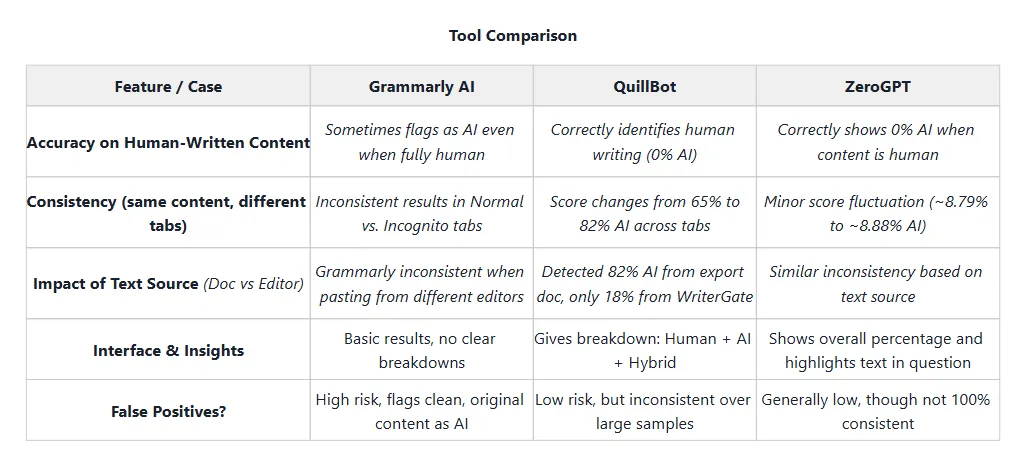
Can AI Detection Tools Really Catch AI Writing? A Quick Comparison
AI detectors promise to separate humans from machines. But how well do they really work?
We tested three popular tools, Grammarly, Quill Bot, and ZeroGPT, across different cases:
- 100% human-written content
- Edited text
- Copied or reformatted inputs
- Browser and editor variations
Here's how they stacked up:
There are humanize AI tools out there, can they fix it?
So, here's the next question many teams ask:
Can't we just run AI content through a humanizing tool and call it a day?
Yes, there are plenty of tools out there claiming to "de-AI" your writing.
They tweak phrasing, break patterns, even reword things to make it feel more… human.
But here's the truth:
While these tools try to hide the AI fingerprint, they rarely add real voice or authenticity.
The output is often clunky or awkward. It might pass AI detectors, but it doesn't read well, And worst of all, it strips out flow, tone, and storytelling
Instead of improving the content, it starts sounding like a bland rewrite. And ironically?
You end up putting more effort into fixing it than if you'd just written it properly in the first place.
These tools patch the surface, but they don't solve the real issue: lack of intention and originality at the core.
How to use AI Properly
After all this, it's natural to ask:
Should we stop using AI for content? The answer isn't no it's "use it wisely."
AI can be helpful. Very helpful. But not as your main writer.
It can assist you, support you, speed things up, but it shouldn't replace your thinking, your voice, or your point of view.
Here's Where AI Does Help:
- Fact-checking: You can ask it to summarize sources or verify ideas before you write
- Grammar and clarity: It can clean up your writing, fix awkward phrasing, and adjust tone
- Link checks: AI tools can help spot broken links or suggest internal/external references
- Style support: If you have a brand tone or writing guideline, it can help you stick to it
- Research assistant: Summarize long papers, find trends, or explore a topic before you dive in
- Productivity boost: It's great for outlines, structuring thoughts, or trimming copy
But Here's Where You Should Stay in Control:
- Original writing
- Personal stories or experience
- Final review and judgment
- Creative voice and tone
Because credibility doesn't come from perfect grammar, it comes from sounding like you, offering insights only you have, and building trust over time.
Your voice, your perspective, your care in saying things well, that's what sets your content apart.
So yes, use AI. But use it like a teammate, not a ghostwriter.
Let it help you sharpen your work, not shape it entirely.
Case Study: Human vs AI Comparison
Let's play a game. (Try this in your article!)
Paragraph A:
The economic consequences of inflation are multifaceted, affecting both macroeconomic and microeconomic indicators.
Paragraph B::
When prices spiked last year, I stopped buying oat milk. It was $6 a bottle insanity. Inflation, man.
Which one do you think is written by AI?
(Answer: Probably A.)
This exercise shows how you can feel the human fingerprint or the lack of it.
Ethical and Practical Considerations
Here's where it gets real: AI isn't evil, it's a tool. The ethics lie in how we use it.
What's Okay?
- Using AI to generate ideas, summarize research, or rewrite drafts.
Being transparent: "This article was written with AI assistance and human editing."
What's Not?
- Passing off pure AI content as your own.
- Using AI to flood the internet with fluff.
ContentBloom
Remember: efficiency ≠ authenticity.
Bonus: Actionable Takeaways for Your Team
Writers:
- Use AI like a co-pilot, not a ghostwriter.
- Always add personal flair, examples, and tone.
Editors:
- Use a checklist: Does this sound too generic? Too smooth?
- Run drafts through a detector and your gut.
Marketers & SEO Pros:
- Don't let your blog become an AI graveyard.
- Blend AI tools with high-authority human insights for best ranking performance.
The Bright Side of AI: A Powerful Assistant
Let's not forget: AI can be amazing.
- It helps non-native writers communicate clearly.
- It speeds up content research and ideation.
- It provides drafts and structure, but you provide the soul.
Just like spellcheck made writing easier, AI can enhance what we do-if we lead with creativity.
 Enlear