The secret to high-output teams isn’t working harder, it’s designing a system where every action creates momentum for the next.
 Imagine your content team like a well-oiled machine, each part doing its job, feeding energy into the next. When things click, the results multiply. When they don’t? You feel the drag: delays, rewrites, confusion.
That’s where a system comes in.
Below, you’ll find ten fully fleshed‑out strategies, each one a gear in the larger machine of scalable content.
You can definitely cherry-pick improvements. But if you want real momentum? The magic happens when they all run together.
 ## 1.Your Content Strategy Starts in Your Buyer’s Mind
Your most powerful editorial calendar? It’s not in a tool-it’s in your buyers’ minds. To tap into it, ditch the guesswork and map your strategy like a product designer would. Create a simple two-axis grid:
- On the vertical axis: list your personas, each key buyer or user type you need to reach.
- On the horizontal axis: lay out the funnel stages, Awareness, Consideration, Decision.
You don’t need fancy software to get started. Just open a Google Sheet and sketch it out. That simple matrix becomes your blueprint for high-impact content planning-targeted, structured, and scalable.
Why it matters
Ever feel like you’re publishing just to fill a calendar? That’s what happens when content isn’t mapped to real people and real needs.
- When you understand who’s reading and why they’re searching, content planning shifts from guesswork to precision. Topics aren’t just ideas, they become answers to questions your buyers are already asking.
And here’s the real win:
- You avoid the all-too-common mistake of stacking three top-of-funnel posts back-to-back, only to realize sales has nothing to nurture leads further down the path.
A well-balanced matrix keeps your messaging aligned across personas and funnel stages. No more "whoops" moments. Just smart, strategic coverage.
How to build it
- Interview sales and customer success for objections they hear every day.
- Mine support tickets, pure gold for “voice of customer” phrases.
- Paste key phrases into Google and note whether the results are how‑to guides, comparison pages, or pricing sheets. The SERP tells you the true intent.
We thought our ICP was CTOs, but the matrix showed 70 % of early traffic came from DevOps managers. That changed everything. - SaaS Marketing Lead
Lock the map, color empty cells, and assign revenue potential to each persona. Now every future outline has a dollar value, and every blank cell becomes a clear editorial opportunity.
2. Build SEO Topic Clusters Around Those Gaps
With journey gaps staring back at you, jump into Semrush, Ahrefs, or LowFruits and turn instinct into data.
Step‑by‑step
- Seed the tool with thematic keywords (“infrastructure automation,” “zero‑trust security”).
- Let it auto‑cluster phrases by semantic similarity and intent.
- Export the clusters and tag each one with the funnel stage you mapped in Strategy #1.
A ‘Kubernetes cost‑optimization’ cluster with 4k monthly searches and almost zero competition became our Q2 pillar.
Why clusters beat one‑offs
- They force you to answer every sub‑question, signaling topical authority to Google.
- They create a self‑reinforcing internal‑link web.
- They let you brief five writers at once, multiplying velocity instead of dribbling out single posts.
Start with one strong pillar page. Add a handful of related posts around it. Top it off with a lead magnet that ties it all together.
Drop that bundle into your calendar, and suddenly, thirty keywords turn into a quarter’s worth of focused, search-friendly content, built to work together, not drift apart.
3.Expand Your Writer Ecosystem
Capacity, not creativity, is the choke point for most teams. Solve it by widening the pool of people who can put words on the page.
Three talent lanes
- Subject‑Matter Experts (SMEs): architects, analysts, clinicians-people with first‑hand authority.
Guest Writers: industry bloggers and partners who bring backlinks and fresh angles.
 ### Recruiting tips
- Post micro‑briefs in niche Slack or Discord channels.
- Pay with a mix of cash, backlinks, and visible bylines, each writer values them differently.
- Issue a one‑page onboarding kit covering voice, style, deadlines, and payment terms so newcomers feel at home by lunchtime.
We grew from four to fifteen monthly articles without adding salary headcount-just a smarter roster.
Retaining the roster
- Host quarterly “writers’ lounge” calls to share traffic numbers and upcoming themes.
- Pay on time, nothing burns bridges faster than Net‑60 invoices.
- Offer stretch assignments (podcast scripts, webinar ghost‑writing) to keep veterans engaged.
More voices mean more depth, broader reach, and resilience when a key contributor is suddenly unavailable.
4.Match Writers to Topics and Destinations
Once you’ve built a strong contributor bench, don’t just delegate tasks, match skill to story. Think like a casting director, not a traffic cop. Assign content based on technical depth, tone, and domain familiarity. Give product walkthroughs to engineers, thought leadership to your most articulate SMEs, and fast-turn pieces to your speed specialists.
This kind of intentional staffing improves first-draft quality, shortens review cycles, and ensures each piece lands with both precision and authority.
The matching formula
Expertise × Outlet Fit = Approval Speed × Audience Trust
Implementation moves
- Maintain a simple spreadsheet of writers’ niches, credentials, and previous publications.
- Tag each content card with the target outlet, your blog, a partner site, or a media publication.
- When you filter by both tags (topic + outlet), only perfectly‑matched writers appear in the “Assignee” dropdown.
Real‑world example
Need a technical comparison piece for an enterprise AI audience on VentureBeat? Hand it to the ex‑IBM architect who has already cleared VentureBeat’s editorial gatekeepers, no relearning, no rewrites, and a byline that readers instantly trust.
Benefits cascade: faster external approvals, stronger brand authority, happier writers covering topics they love.
5.Bake Quality In-Don’t Polish It Later
Think of quality like security in software: cheaper left, expensive right.
Shift‑left tactics
- Link a living style guide and SEO checklist in every brief.
- Require writers to run automated checks-Grammarly, Language Tool, or custom LLM prompts-before submission.
- Enforce a self‑certification tick box (“I’ve performed all checks”) so drafts arrive 90 % publish‑ready.
- Let editors focus on narrative flow and insight, not comma patrol.
If I’m line‑editing commas, the system failed upstream. - Senior Editor
When your system works, revision loops shrink from five rounds to two. Editors get their time back to focus on thought leadership, not firefighting. Publish dates hold steady. And every downstream team, from social to sales, finally knows they can trust the calendar.
6.Give Everyone a Single Source of Truth
Chaos loves silos; kill them with transparency. Whatever project board you choose, Writer Gate, Trello, Notion make it the first browser tab every stakeholder opens.
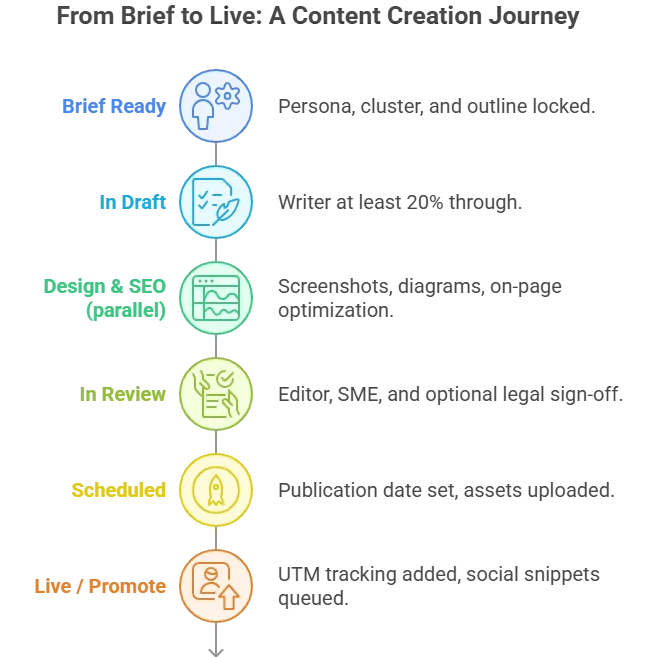 Automation is your silent teammate. Set up Slack or Teams to notify you the moment a card moves columns. Pin key links, Figma mocks, Drive docs, right inside the card, so no one’s hunting for assets. Run a quick 15-minute triage each week to clear blockers fast. And if a card sits untouched for more than five days? Escalate it immediately. No ghost tasks. No silent delays.
Visibility doesn’t slow people down-it frees them from endless ‘status update’ meetings.
7. Run Tasks in Parallel, Not in Parade Formation
Sequential workflows feel safe, but they quietly drain your speed. The fix? Lock the outline early and treat it like an architectural plan. Once it's set, writers, designers, and SEO can build in parallel. No waiting, no blockers, just one blueprint, many hands, and momentum from the start.
Parallelizing Playbook
- Designers begin image sourcing the moment H2s are final.
- SEO specialists draft meta titles and FAQ snippets while the body copy is only half‑written.
- Social marketers craft promo copy from pull‑quotes flagged in the outline.
Our average time‑to‑publish dropped 40 % in the quarter we outlined a freeze point. - Content PM
Where true sequence is unavoidable, legal review, external partner approval, translation, reserve buffer slots on the board so other stories aren’t blocked behind them.
8.Arm Creators With Automation
Great tools shave minutes off every task; minutes compound into weeks each quarter.
Toolkit essentials
- Grammarly Premium for grammar, tone, and concision.
- Surfer SEO or Clearscope for real‑time keyword coverage.
- Curated Chatgpt prompts for competitive gap analysis, analogy brainstorming, and headline ideation.
- Canva Brand Kit loaded with your colors and fonts for instant social graphics.
Roll out with a small pilot, share Loom tutorials instead of 12‑page manuals, and bulk‑license only once ROI is proven.
Once writers realized Grammarly caught 90 % of passive voice, edits turned from bloodbath to breeze.
Automation isn’t here to replace your team, it’s here to free them. Let the machines handle the repetitive, the routine, the mechanical mess. That way, your people can focus on what actually moves the needle: insight, creativity, and strategy. Less busywork. More brainwork.
9.Measure, Review, Iterate
Without measurement, scale drifts into expensive sprawl. Choose three scorecards and review them monthly:
- Organic Visibility: keyword positions, impressions, and click‑through rate.
- Engagement Health: time on page, scroll depth, assisted conversions.
- Pipeline Efficiency: average days in each board column, number of blocked cards.
Run a 30‑minute retro asking:
What surprised us? Which bet flopped? What will we test next?
Document action items, new schema markup, removing friction in legal review, doubling down on comparison posts and assign owners right away so insight becomes iteration, not shelf ware.
Celebrate tiny wins (metrics Slack channel), treat misses as data, and you’ll preserve the experimental energy that makes great content engines hum.
10.Refresh and Repurpose Your Greatest Hits
Every asset holds more value than its first published date suggests.
Play the hits
- Update statistics, quotes, and screenshots; bump the date; re‑launch to your mailing list.
- Repurpose: blog → slide deck, slide deck → LinkedIn carousel, carousel → short‑form video script.
- Redistribute via syndication (Medium, industry newsletters) to capture new eyeballs with minimal lift.
A refreshed 2019 tutorial regained Rank 2 and added 8k organic sessions in 30 days cheaper than a brand‑new post.
Sometimes your next best post isn’t new, it’s already live and quietly aging.
Run a quarterly decay audit in Semrush to catch slipping performers before they fall too far. Do a monthly check on your top converters, make sure they’re still accurate, relevant, and earning their keep. And build a weekly habit of clipping evergreen gems into bite-sized micro-content.
One solid hour of refresh can out-earn ten hours of writing from scratch. When budgets tighten, that’s not just smart, it’s essential.
Final Take‑Away
Each loop tightens the system, freeing your team to chase bigger ideas instead of deadlines. Implement, tweak, and watch “too much content” transform from crisi to confidence.